Complete University Elevator Management Solutions for Higher Education Facilities
Managing elevators on a university campus is a task that goes beyond simple repairs. With a mix of high-traffic academic buildings, 24/7 residence halls, and specialized research facilities, universities require a systematic approach to vertical transportation. Effective management maximizes safety, regulatory compliance, and everyday functionality. This guide outlines how a strategic management plan can improve reliability across a higher education portfolio.

Why Is a Strategic Approach to Elevator Management Crucial for Universities?
In universities, elevators serve as critical infrastructure. Unlike a standard office building, campus elevators face unique demands that require more than just a basic service contract. A strategic approach or university facility management solution is critical because it:
Ensures Accessibility
Accessibility is a core requirement for higher education. Under the Americans with Disabilities Act (ADA), functional elevators are required to ensure equal access for all students, staff, and visitors in multi-story buildings. When an elevator goes down, it can effectively bar a student with a mobility impairment from attending a class or laboratory, creating an immediate compliance failure.
A strategic management plan keeps elevators operational and compliant with modern accessibility standards, reducing the risk of legal liability and ensuring an inclusive campus environment.
Maintains Operational Continuity
Dormitories and campus facilities require 24/7 uptime. Unlike commercial offices that close in the evening, university life is continuous. A breakdown at midnight in a student residence can be a logistical hurdle and a significant safety and student-experience issue. Strategic management allows elevators to handle high traffic during class changes, preventing long wait times and overcrowding.
Addresses Aging Infrastructure
Many campuses contain a wide variety of elevator brands, ages, and technologies, ranging from historic freight lifts in the arts department to modern high-speed units in science towers.
A strategy helps you identify which units need immediate replacement rather than continued maintenance, allowing for better capital budget planning. Modernization can bring outdated equipment up to current safety codes, including enhanced emergency communication, firefighting, and seismic safety.
Simplifies Resource Allocation
Elevator portfolio management providers treat the entire campus fleet as a single, interconnected asset. This strategic approach allows facilities managers to track performance trends, identify problematic units before they fail, and move toward a data-driven management model. This transition enables more predictable budgeting and more effective labor allocation.
Key Components of a University Elevator Management Plan
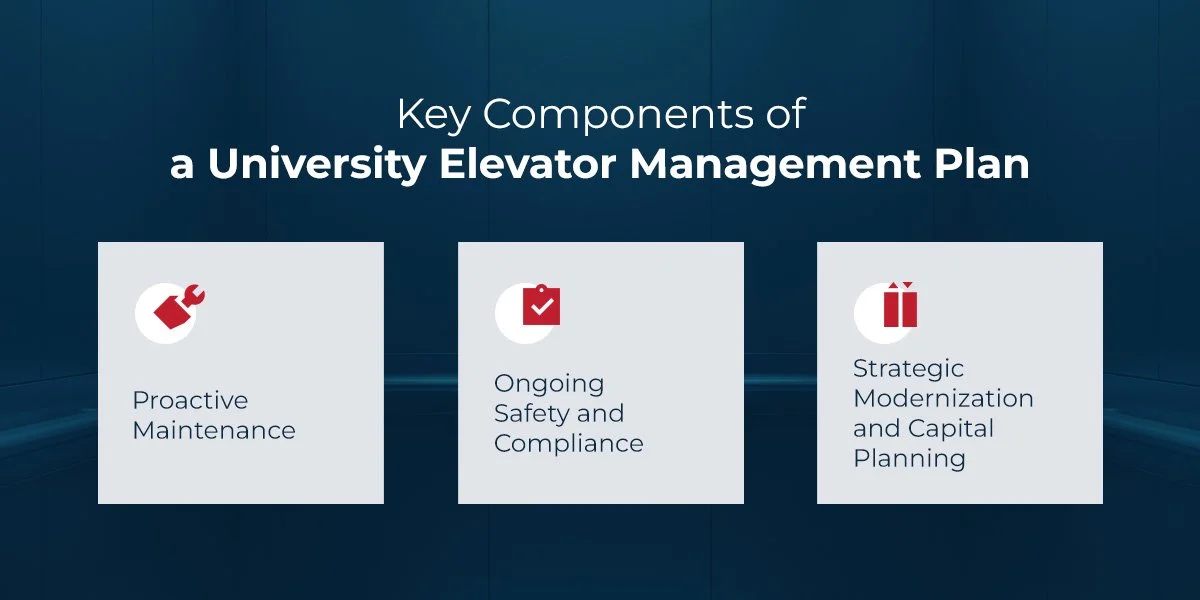
A successful plan relies on proactivity, strict compliance, and long-term financial planning.
Maintenance Oversight
Reactive maintenance is the most expensive way to manage an elevator. It leads to unexpected downtime, emergency repair premiums, and potential compliance violations.
A proactive approach includes investing in maintenance oversight to identify areas of improvement and weaknesses. For a university elevator service provider, the goal is to maximize the mean time between failures and keep your systems functioning properly.
Consistent higher education lift maintenance also reduces the total cost of ownership by preventing minor issues, such as a worn door gib or a loose contact, from escalating into a total system failure that requires expensive component replacement. Elevator maintenance evaluations keep you informed about the condition of your systems so you can schedule service accordingly.
Ongoing Safety and Compliance
Elevator codes are updated frequently, and staying compliant is a major administrative task. Following ASME A17 safety standards is essential for passing inspections and protecting passengers. Compliance is not a one-time event, but rather a continuous cycle of testing and documentation. Scheduling regular high-quality inspections is a critical part of ensuring your elevators are up to date and as safe as possible.
Reliable university emergency elevator communication is a critical factor in maintaining safety and compliance. Every cab must have a working communication system that reaches a monitored location 24/7. Ensuring that all safety tests, such as Category 1 and Category 5 testing, are performed on schedule, is an important part of monitoring elevator code compliance for universities.
Strategic Modernization and Capital Planning
Many campuses have aging equipment that is difficult to maintain because certain parts are no longer manufactured. Without a plan, these units may eventually fail permanently, leading to massive, unbudgeted expenses.
Elevator capital planning for universities involves assessing the condition and remaining useful life of every unit on campus to create a modernization roadmap of five to 10 years. This allows the university to forecast expenses years in advance and schedule upgrades during summer breaks or winter recesses when campus traffic is at its lowest. Effective elevator portfolio management helps prevent the budget shock of a sudden modernization requirement.
The Benefits of a Centralized Elevator Management Strategy
A centralized approach to university vertical transportation solutions consolidates data and vendor management. Instead of individual facility managers or facility teams dealing with multiple contractors and inconsistent service levels, a centralized strategy provides:
Improved cost efficiency: Consolidating maintenance contracts across 20 or 50 buildings provides significant leverage, leading to better pricing and more rigorous Service Level Agreements (SLAs)
Unified data and reporting: A single platform for tracking repairs, downtime, and inspection results allows for high-level reporting that can be presented to university boards or finance committees.
Streamlined communication: With a single point of contact for campus elevator management, there is no confusion regarding who is responsible for uptime. This eliminates the finger-pointing that often occurs when multiple vendors are involved in a single building's systems.
Simplified oversight: Centralizing management under a single strategy simplifies the oversight of a large, diverse portfolio and ensures that standards are applied uniformly across all departments.
How to Choose the Right Elevator Management Partner
The right partner should act as a manager and advocate for the university, not just a service company. When evaluating a provider, look for the following:
Sector expertise: A provider should have experience managing the high-pressure environment of a university campus.
Independence: A partner that is independent of elevator manufacturers can offer unbiased advice. You receive data-driven assessments of your equipment’s condition, ensuring you only spend money on necessary repairs and upgrades.
Comprehensive services: Your partner should handle everything from routine maintenance auditing to long-term capital planning and full-service code compliance.
Modernization capabilities: Choose a partner who can handle modernization, upgrades, and integration of new technologies.
Simplify Your University's Elevator Management With ATIS
ATIS is a leader in providing comprehensive elevator management solutions specifically tailored for the higher education sector. We help universities navigate the technical, regulatory, and financial challenges of maintaining a large elevator portfolio.
Our Total Elevator Asset Management (TEAM) service provides a complete oversight solution. We act as an extension of your facilities department, providing the expertise required to manage the entire asset life cycle. This solution includes asset, certificate, and inspection management. Streamline your campus-wide operations and learn more about our Total Elevator Asset Management (TEAM) service.
ATIS offers specialized services in safety inspections and elevator compliance management, serving as a strategic partner to ensure your campus remains safe and your costs remain under control. We provide the expertise needed to turn elevator management from a daily headache into a streamlined, predictable part of your facilities operation.
Transform your campus operations with a university-focused elevator management plan.