Elevator Maintenance Specifications Guide: How to Write Contracts That Protect Your Investment
Most elevator maintenance contracts are written by the contractor, which means every clause, exclusion, and performance standard defaults to what's best for them, not you. Property owners and managers who sign without clear specifications in place often find out what's missing after something goes wrong — for example, poor elevator service quality, or a service gap that the contract “technically” allows.
A well-written elevator maintenance specification changes that dynamic. Discover the relationship between elevator maintenance specifications and contracts, the essential elements of comprehensive maintenance specifications, and how to spot unfavorable terms. You'll learn how to negotiate agreements that protect your building and reduce surprise costs.
What Is the Difference Between an Elevator Maintenance Specification and a Contract?
An elevator maintenance specification dictates “how” the elevators are to be serviced, while an elevator maintenance contract is a legally binding agreement that dictates “what” is covered and the commercial terms.
Maintenance Specification
A maintenance specification is a technical document that establishes the required service standards before you solicit bids from contractors. It details how often the elevator must be lubricated, how parts should be adjusted, safety testing procedures, and the qualifications required of the mechanics performing the work.
This document is your quality-control tool. You use it during elevator service contractor selection to ensure you only enter into legally binding agreements that protect your investment.
ATIS offers maintenance specification services designed to help property owners and managers hold vendors accountable. We start with a meeting to determine your needs, then assess the equipment and review your requirements, making adjustments and revisions as needed. Afterward, we guide the specification through a Request for Proposal (RFP) process so you can find vendors who align with your specification.
Maintenance Contract
A maintenance contract outlines the legal terms, including your monthly fee, what happens if you want to cancel, and exactly who pays for broken parts or emergency repairs. It tells you how much your budget will be and what you are protected against.
Why Preventive Elevator Maintenance Contracts are a Strategic Investment
Preventive elevator maintenance services can protect your property's value, support legal compliance, and reduce unexpected downtime if crafted properly. Here's how service agreements help you achieve significant long-term savings:
Life cycle cost control: Routine servicing can extend equipment lifespan, delaying the massive capital costs associated with early elevator replacement or major modernization.
Financial predictability: Maintenance contracts spread costs evenly over time, ensuring consistent, predictable budgeting for building owners and managers.
Legal and code compliance: Regular maintenance supports compliance with strict local AHJ codes and laws, helping reduce your risk of fines and liability claims.
Tenant retention and asset value: Keeping elevators fully operational maximizes tenant satisfaction and preserves the overall market value of your real estate investment.
Enhanced safety and uptime: Proactive care reduces the risk of catastrophic failures and passenger entrapments.
Most elevator maintenance contracts are written by the contractor, which means every clause, exclusion, and performance standard defaults to what's best for them, not you. Property owners and managers who sign without clear specifications in place often find out what's missing after something goes wrong — for example, poor elevator service quality, or a service gap that the contract “technically” allows.
A well-written elevator maintenance specification changes that dynamic. Discover the relationship between elevator maintenance specifications and contracts, the essential elements of comprehensive maintenance specifications, and how to spot unfavorable terms. You'll learn how to negotiate agreements that protect your building and reduce surprise costs.
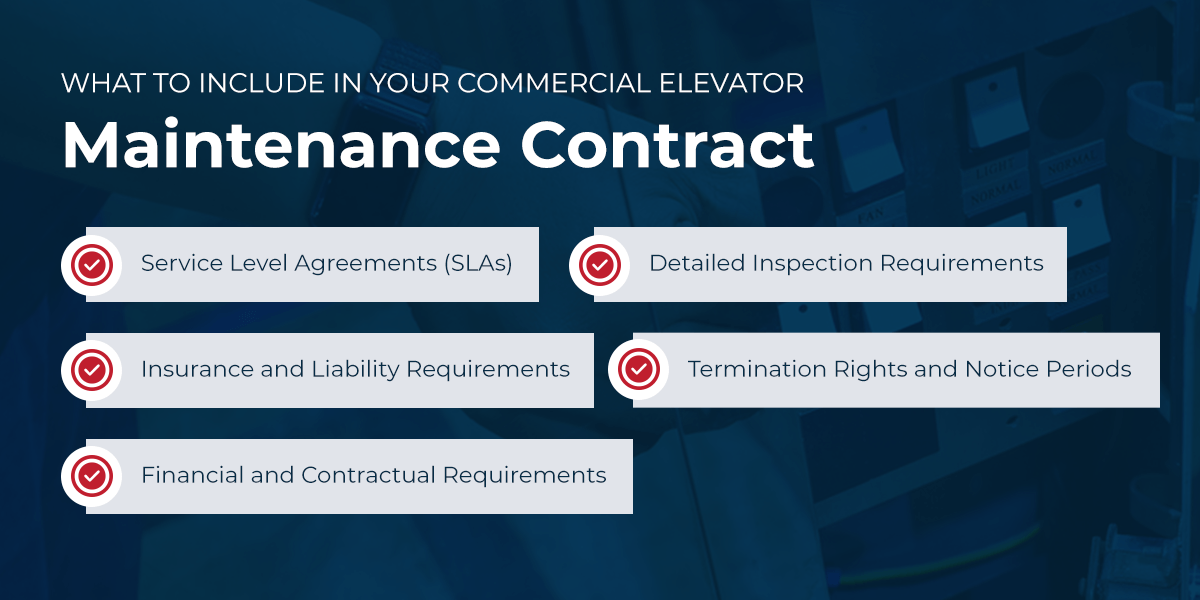
What to Include in Your Commercial Elevator Maintenance Contract
To ensure your elevator is properly maintained and your interests are protected, your contract should include the following elements:
Service Level Agreements (SLAs)
Your contract should define the level of service you expect, including response times and routine maintenance. For example, you can require a 24/7 emergency call-out service with guaranteed response times, such as arriving on-site within 60 minutes for passenger entrapments and within 2–4 hours for standard elevator breakdowns.
Clearly separate preventive maintenance from reactive maintenance. Preventive maintenance includes planned activities such as inspections and equipment adjustments, while reactive maintenance involves repairs in response to equipment failures, faults, or service requests. Outlining the scope of work and the pricing for both types of maintenance helps prevent misunderstandings and ensures that neither is overlooked or omitted from the agreement.
You should also address the frequency of maintenance visits. The safety code for elevators and escalators (ASME A17.1) does not mandate specific visit frequency. Your contract should clearly state how often preventive maintenance visits will occur and the tasks to be performed during each visit.
Detailed Inspection Requirements
Your contract should clearly outline which components and safety systems are covered during routine maintenance visits and formal inspections. Comprehensive safety inspections typically occur once or twice per year and involve formal testing of all safety systems and verification of code compliance. Maintenance calls occur more frequently and usually focus on preventive care, such as cleaning, lubrication, adjustments, and operational checks, to keep equipment running reliably between formal inspections.
At a minimum, your contract should address the following components and systems:
Safety systems: Emergency brakes, overspeed governors, fire recall functions, and smoke detection systems.
Elevator cab and doors: Door sensors, safety edges, leveling accuracy, emergency lighting, communication systems, and overall door operation.
Machine room and pit: Controllers, drive units, wire ropes, or belts, along with the overall condition of the machine room and pit to ensure they remain clean, dry, and within the required environmental conditions.
Insurance and Liability Requirements
Elevator failures can result in serious injuries. Without proper insurance coverage, a building owner may face liability for injuries caused by contractor negligence.
Include minimum insurance requirements in your specification so vendors submit proof of coverage as part of the bid process. Your specification should require the contractor to maintain appropriate insurance coverage, including general liability, workers' compensation, and vehicle liability. Verify it remains active throughout the contract term and ensure the building owner is protected with language that holds the contractor accountable for claims arising from their negligence or faulty workmanship.
Termination Rights and Notice Periods
Your specification should clearly explain when either party can terminate the agreement and the notice required. It should also define the circumstances that allow termination for cause. Examples include:
Failing to respond to emergency breakdowns
Breaching safety obligations
Allowing required licenses or certifications to lapse
Clearly defining these conditions allows you to end the contract promptly if the contractor fails to meet their obligations.
Financial and Contractual Requirements
Include clear commercial terms to eliminate any uncertainty about pricing, performance expectations, or parts availability. Important items to address include:
Billing and annual price increases: Limit annual rate increases by linking them to a recognized Consumer Price Index (CPI) or setting a maximum increase, such as 3%–5% per year.
Performance penalties: Specify financial penalties or contract remedies if the contractor repeatedly misses maintenance visits, fails to meet agreed response times, or delivers consistently poor service.
Parts availability: Require the contractor to keep commonly used Original Equipment Manufacturer (OEM) parts in stock, or have reliable access to them, to minimize equipment downtime.
Hidden Elevator Service Agreement Pitfalls to Avoid
The greatest contract risks often come from language that appears harmless during procurement but later creates leverage for vendors. Watch for these common pitfalls:
Vague language and undefined terms: Phrases like "as needed" or "industry standard" are open to interpretation and can lead to disagreements.
Auto-renewal clauses: Many contracts renew automatically for another full term unless you cancel within a specific notice period. Review renewal best practices to ensure the renewal terms provide enough flexibility and are manageable.
Exclusions for major components: Some contracts appear to provide comprehensive coverage but exclude components that are costly to repair or replace. Ask for a complete list of excluded items before signing any agreement.
Cost considerations: Agreeing to terms based on price alone means you could end up spending more in the long-term. When comparing contracts, make sure to consider factors like response times, the scope of coverage, parts access, and escalation clauses.
Obsolescence clauses: Contracts may include language allowing the contractor to declare equipment "obsolete" and either terminate the agreement or exclude parts from coverage. Without a clear definition of obsolescence and advance notice requirements, contractors can use this clause to force expensive modernizations or exit contracts when maintenance becomes less profitable.
Work With an Independent Elevator Consultant
A well-written elevator maintenance specification sets the standard, defines accountability, and gives you real leverage when a contractor falls short. But getting the language right requires technical knowledge that most facility teams don't have in-house, and a missed clause can cost you far more than a consultant ever would.
That's where ATIS comes in. We offer custom maintenance contract and RFP consulting to ensure elevator maintenance agreements include the right coverage, eliminate surprise costs, and give you termination rights when service quality declines. Our team works exclusively on behalf of building owners and property managers, which means our only priority is protecting your interests.
Contact us to learn more about writing elevator maintenance contracts that protect your investment.