Hotel and Hospitality Elevator Excellence - Ensuring Seamless Guest Experience
Guests in your hotel ride the elevator multiple times a day. When it works seamlessly, no one notices. When it doesn't, it's often the first complaint to appear in a review.
For facility managers, that creates a unique challenge. You're responsible for vertical transportation performance across the property, but relying only on maintenance contractor reports makes it difficult to determine what's actually happening behind the scenes. With the proper independent oversight, you'll have a better framework for understanding what elevator excellence really looks like, including reliability, usage demands, aesthetics, and safety.
How Elevator Performance Affects Guest Satisfaction and Reviews
Elevator reliability is directly tied to guest satisfaction. Research published in 2025 found that tangible facility issues account for 83% of consumer complaints in online hotel reviews. Elevators are among the amenities flagged in negative reviews. Downtime, noise, and worn cab interiors all signal poor property upkeep to guests.
In 2025, guest satisfaction with hotel facilities maintenance declined significantly as operating costs rose at third-party managed hotels. But in 2026, hotels that invested in property upkeep saw facility satisfaction improve 14 points. That gap is the argument. Guests read a broken elevator the same way they read a dirty room. It tells them the property doesn't care.
Conversely, elevators that run quietly, look sharp, and respond quickly reinforce every other aspect of the stay. This makes proactive, independent oversight essential.
High-Frequency Use and What It Demands from Hotel Elevators
Hotel elevators are in a category of their own when it comes to wear and demands. Unlike office buildings, which have predictable morning up-peaks, lunch peaks, and evening down-peaks, hotel elevators run in unpredictable, two-way traffic patterns 24 hours a day, seven days a week. Check-in and checkout surges, housekeeping carts, room service, luggage trolleys, and event crowds hit elevators with loads and patterns that standard planning criteria don't fully anticipate.
Hotel elevator planning research supports this reality. Five-star hotel standards require handling capacity exceeding 12% per five minutes, with waiting times under 30 seconds. Hotels rely on two-way traffic with no predictable quiet periods. The average elevator carries approximately 20,000 people per year, and hotels with high occupancy, event traffic, or heavy luggage and service-cart use may place additional demand on their elevator systems.
This volume accelerates wear on doors, ropes, hydraulic systems, and mechanical components. The implication is that hotels need more than routine oversight cycles or general hotel property elevator services. They need hotel elevator assessment services that reveal actual equipment health, not just what a vendor tells them, so capital planning is based on real data, not assumptions.
Aesthetic Integration and How Elevator Design Reflects the Property
The elevator cab is a branded environment, not just a functional box. Guests spend meaningful time inside it, and the condition of the finishes, lighting, flooring, and panels communicates something about the property's standards. A worn cab in a freshly renovated hotel creates a jarring disconnect. For many guests, the elevator is the first interior space they encounter after checking in, making it a critical first impression that sets expectations for the rest of the property.
When you invest in hotel elevator modernization, the goal isn't just mechanical performance. It's preserving the property's aesthetic identity. Boutique and historic hotels in particular need to work with specialists who understand how to spec cab interiors that match the property's design language, not just a standard contractor catalog.
The Peabody Hotel modernization project is a real example of this approach. Independent consulting guided the modernization, including refinishing elevator cabs and preserving decorative elements that reflect the hotel's historic character, all managed within budget and with minimal guest disruption. Aesthetic upgrades are part of hospitality facility elevator consulting and capital planning. When evaluating options, include aesthetic evaluation in any condition assessment or planning process.
Guest Safety Protocols Every Hotel Property Needs
Hotel elevators in the United States and Canada are commonly governed by locally adopted versions of ASME A17.1/CSA B44, the primary safety code for inspections, load testing, safety devices, and emergency communications. Requirements vary by jurisdiction, so always consult the local Authority Having Jurisdiction, or AHJ, for specific code requirements in your state or province.
Recent code updates from the 2019 ASME A17.1 edition include new requirements for visual and text-based communication to assist guests with the following:
Hearing or speech impairments
Real-time video feeds inside the cab
On-site assistance notification
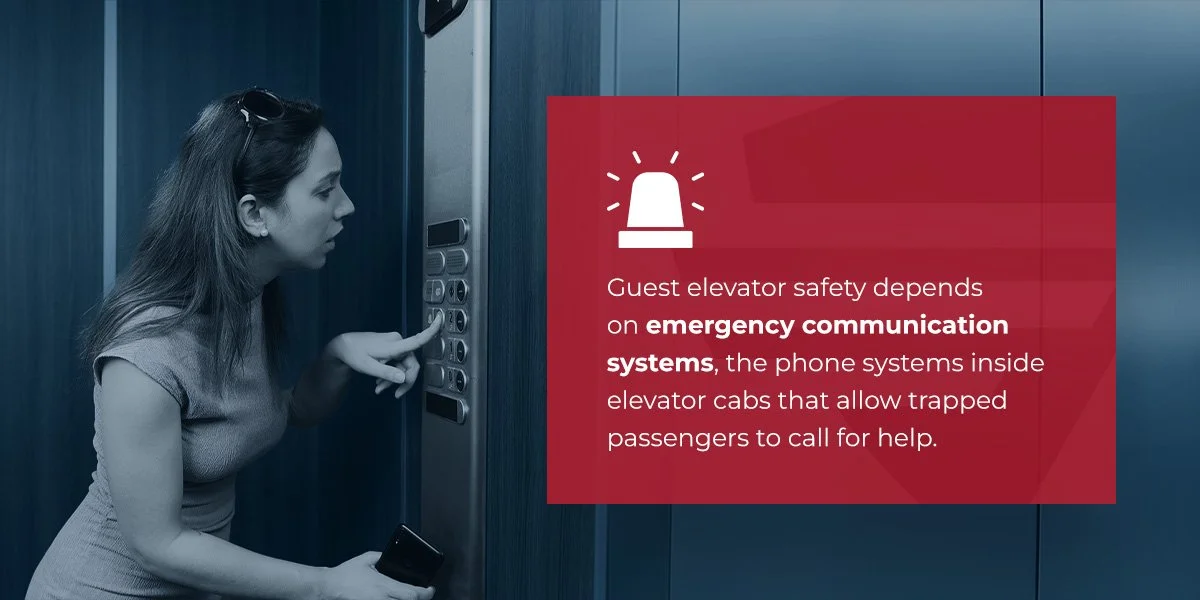
Guest elevator safety depends on emergency communication systems, the phone systems inside elevator cabs that allow trapped passengers to call for help. Many properties still use outdated POTS (plain old telephone service) lines that are being phased out in favor of modern VoIP systems. These systems often go unnoticed until inspection or until something goes wrong.
Certificate management is a distinct service from inspections. The AHJ issues certificates, but independent partners can help manage the process. Hotels must also have documented emergency procedures for their teams, including protocols for entrapment scenarios.
Maintenance Scheduling Strategies That Minimize Guest Disruption
Inspections, condition assessments, and any related work should be coordinated around the property's occupancy calendar, such as low-occupancy windows, off-peak hours, and shoulder seasons. But scheduling alone isn't enough. The deeper issue is oversight or hotel elevator management.
Hotels that rely entirely on their hospitality elevator maintenance contractor to self-report performance gaps have a conflict of interest baked into the relationship. A vendor with a financial stake in the scope of work is not a neutral advisor, which is the argument for independent elevator oversight.
Independent consulting reviews service contracts to ensure they're structured correctly, while managed services teams audit invoices, verify performance, and hold vendors accountable. This includes catching invoice discrepancies and ensuring work aligns with the property's actual needs rather than vendor revenue goals.
Partner With ATIS for Hotel and Hospitality Elevator Excellence
Elevator excellence results from proactive, expert, independent oversight. Whether you're managing a boutique property or a multilocation portfolio, ATIS delivers the full spectrum of hospitality elevator services. We provide consulting to guide modernization and capital planning, and inspections backed by North America's largest network with deep state-specific and provincial compliance knowledge.
We also offer managed services that hold vendors accountable while coordinating around your occupancy calendar. From condition assessments to emergency communication systems, TEAM combines inspections, asset management, and certificate management into a single solution. It converts unpredictable capital expenses into predictable monthly costs, simplifying budgeting and planning for properties of any size.
We bring the independent expertise that turns vertical transportation into a competitive advantage. Contact us today to connect with a consultant who understands the hospitality environment, or learn more about our hospitality services and see how we support hotels and resorts nationwide.
Linked Sources
https://www.jdpower.com/business/press-releases/2026-north-america-hotel-guest-satisfaction-study/
https://liftescalatorlibrary.org/paper_indexing/papers/00000051.pdf
https://nationalelevatorindustry.org/wp-content/uploads/2019/02/Fact-Sheet.pdf
https://atis.com/posts/the-importance-of-elevator-assessments
https://atis.com/posts/your-elevators-and-disaster-preparedness
https://atis.com/posts/5-things-you-should-know-about-capital-planning