Senior Living Elevator Management: Supporting Safety, Compliance, and Resident Well-Being
Senior living and assisted living communities are built around residents who depend on consistent support to move safely through daily life. Here, elevators are essential infrastructure tied directly to mobility, dining, recreation, therapy, and emergency care.
For many residents, stairs are not an option. Add in 24/7 care demands and a population that includes nonambulatory residents, and the stakes around senior living elevator maintenance look different from those in a typical commercial building. When an elevator goes down here, the disruption extends straight into care delivery, carrying safety and regulatory consequences.
Why Elevator Reliability Is a Life-Safety Issue in Senior Living
Reliable elevators reduce fall risk for elderly residents who need mobility support. According to 2022 CDC data on residential care communities, 71% of residents needed assistance with walking, including the use of a cane, walker, or wheelchair, and 57% needed assistance transferring in and out of a bed or chair. Stretchers and emergency responders cannot navigate stairwells either, making elevator access a clinical necessity during a medical emergency.
Senior health and caregiving routines in senior living depend heavily on reliable vertical transportation. Elevator reliability in these communities is a life-safety issue, not a convenience.
Navigating Compliance for Senior Living Elevators
Senior living facilities face a more layered set of compliance obligations than a typical commercial property. Meeting assisted living elevator compliance requires satisfying three distinct, overlapping regulatory tracks:
ASME A17.1 safety code: This national code sets Maintenance Control Program (MCP) requirements, requiring a written program on-site at all times, with maintenance records retained for at least five years and viewable by elevator personnel at any time.
ADA elevator compliance: Brief service interruptions for repairs are generally unavoidable, but ADA elevator accessibility requirements mandate that features be kept in working order. Failing to make prompt repairs can put a community at risk of violating federal accessibility requirements.
State licensing and survey risk: State health surveys and CMS Life Safety Code surveys for Medicare- and Medicaid-certified nursing facilities evaluate elevator compliance criteria, including whether elevators comply with applicable ASME requirements, whether Firefighter’s Service is operated monthly with a written record, and whether new and existing elevators meet the relevant safety code requirements.
Inspection intervals and code editions vary by location. Confirm requirements with your local Authority Having Jurisdiction (AHJ). A professional condition assessment can also confirm whether your maintenance control program and documentation are survey-ready.
Emergency Elevator Evacuation for Nonambulatory Residents
Evacuation planning is a compliance dimension that senior living operators must address. For nonambulatory residents, exiting through a stairwell is not a viable option during a fire or other emergency, making senior living elevator evacuation protocols essential.
Phase I Emergency Recall and Phase II Emergency In-Car Operation
During a fire alarm event, the Phase I emergency recall automatically returns elevator cars to a designated floor for use by the fire department. Phase II operation lets firefighters manually control an individual car from inside the cab, reaching nonambulatory residents on upper floors.
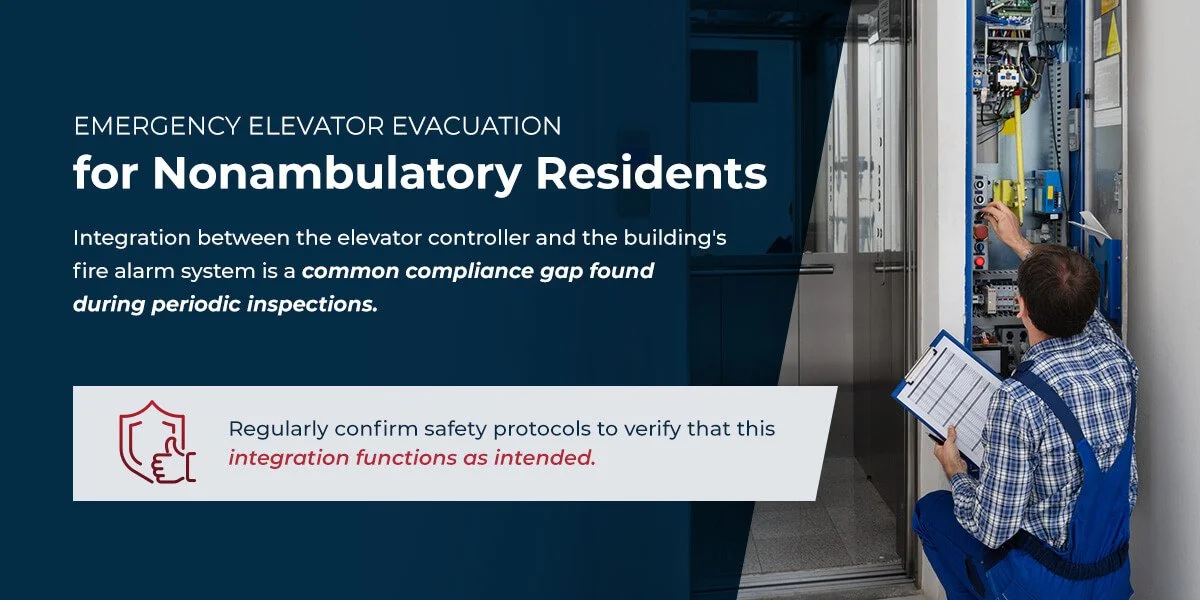
Integration between the elevator controller and the building's fire alarm system is a common compliance gap found during periodic inspections. Regularly confirm safety protocols during a fire or emergency alarm to verify that this integration functions as intended at each senior living elevator inspection.
Automatic Rescue Operation (ARO) Systems
An automatic rescue operation system, also called an automatic rescue device, is a backup system that can move a stalled elevator car to a designated or appropriate landing and open its doors during a power outage, depending on the elevator type and system design. This feature is critical for residents who cannot exit a stalled cab independently and reduced the need for manual rescue during an emergency.
Costs of Elevator Downtime in a Senior Living Facility
Senior living facility elevator downtime presents a 24-hour risk. Unlike an office building or retail store, there are no off-hours periods when an outage is acceptable. When an elevator fails, residents on upper floors lose access to the dining room, therapy suite, medication administration, and outdoor areas. As a result, staff must reorganize meal delivery, medication rounds, and care routines across every affected floor.
When a facility relies on a single elevator, there's no margin for error when something breaks. One outage affects the entire upper-floor population simultaneously. An outage coinciding with a state health survey or Life Safety Code inspection can result in a citation, and family members who witness elevator failures form negative, lasting impressions about care quality.
Implementing a Proactive Elevator Maintenance and Inspection Framework
Shifting from reactive elevator repairs to proactive oversight starts with independent verification, financial accountability, and an approach aligned with your facility's scale.
Independent Condition Assessments
An independent, third-party condition assessment looks beyond a maintenance vendor's self-reporting and evaluates your program across four key areas:
Is the Maintenance Control Program current and on-site?
Is required maintenance being completed?
Is documentation organized and survey-ready?
Do physical equipment conditions match the vendor's service records?
This comprehensive evaluation can help identify elevator-related safety risks for elderly residents and inform next steps for a stronger senior living elevator maintenance program.
A well-managed senior living elevator inspection program shouldn't rely solely on a service provider's word. Because code requires the MCP to stay on-site and viewable at all times, an independent assessment confirms whether that baseline is actually being met.
Invoice Auditing and Vendor Contract Review
Poorly structured vendor contracts are a common source of unnecessary spending. Senior living facilities often have no reliable way to confirm whether invoices reflect work actually performed or whether contract terms favor the facility. Invoice auditing catches charges for services already covered under the maintenance contract, inflated parts costs, and service calls that should have been included in the base agreement.
A thorough contract review should evaluate response times, uptime expectations, escalation protocols for single-elevator facilities, and documentation obligations.
Tailored Approach by Operator Scale
The right oversight framework looks different depending on the scale of your operation:
Single-site operators: A community with one or two elevators benefits most from shorter service intervals, demanding vendor response times, and a condition assessment confirming the equipment meets the standard its residents need.
Smaller multisite operators: Regional groups with several communities must maintain consistent compliance across locations that may fall under different state jurisdictions and AHJ requirements, often without the internal resources of a larger organization.
Large portfolio operators: National Real Estate Investment Trusts (REITs) often have dedicated facilities teams and standardized vendor contracts that smaller operators cannot access on their own, making independent third-party oversight the practical equivalent.
Why Facility Managers Trust ATIS for Senior Living Elevator Oversight
We inspect more than 100,000 elevators and escalators annually across North America. And because ATIS started as an inspection company, compliance and code expertise are foundational to what we do.
As your independent third-party partner, we have no financial ties to maintenance vendors or manufacturers. Our recommendations for your senior living community are built entirely around what your residents and compliance programs actually need.
Our Total Elevator Asset Management (TEAM) suite brings inspection services, certificate management, and asset oversight together in one solution, so facility directors managing one community or many can avoid coordinating across multiple vendors and jurisdictions on their own.
Partner With ATIS for Senior Living Elevator Reliability
Whether you operate a single community or a multisite portfolio, understanding where your elevator program stands starts with an assessment that takes a look at your maintenance records, inspection history, and vendor agreements. ATIS will provide a clear, unbiased picture of whether your equipment, documentation, and compliance are ready to support the residents who depend on them every day.
Contact ATIS to schedule an elevator assessment or compliance review, and start building a more reliable elevator program.